All 7 Kilimanjaro Routes Compared: Which Path to the Summit Is Right for You
Choosing your Kilimanjaro route is the second most important decision you will make after choosing your operator. The mountain has seven established paths to Uhuru Peak at 5,895 meters. Each one has a different character, a different success rate, a different price, and a completely different type of scenery. Some routes are gentle and gradual. Others are steep and relentless. Some carry hundreds of trekkers. Others feel like you have the mountain entirely to yourself.
I have guided climbers on every route Kilimanjaro offers, and the pattern I see repeated constantly is this: people who choose the right route for their fitness, their schedule, and their tolerance for discomfort tend to summit. People who choose based purely on price or duration tend to struggle. This guide breaks down every route with the detail you need to make a confident choice, including day-by-day itineraries, real success rate data, and the honest trade-offs that marketing brochures leave out.
How Kilimanjaro Routes Work
All seven routes converge on the same summit, Uhuru Peak. They share the same final approach through either Barafu Camp or Kibo Hut. What changes is the direction you approach from, the number of days you spend on the mountain, the acclimatization profile your body experiences, and the ecosystems you walk through. Understanding these differences matters because they directly predict whether you reach the top.
The routes are managed by TANAPA (Tanzania National Parks Authority) and accessed through licensed operators. Independent climbing is illegal. Every climber must be accompanied by a registered guide, and porters carry equipment and supplies. Park fees are charged per day, so longer routes cost more in fees but deliver significantly higher summit success rates. Compare all routes on the KiliDestination trekking page.
Machame Route: The Most Popular Path (6 to 7 Days)
Why Machame Is the Default Recommendation
The Machame Route, sometimes called the Whiskey Route, accounts for roughly 40% of all Kilimanjaro climbers. Most experienced operators recommend it for first-timers with moderate fitness because it hits the sweet spot between success rate, scenic variety, and cost. If you genuinely cannot decide which route to take, Machame is almost certainly the right answer.
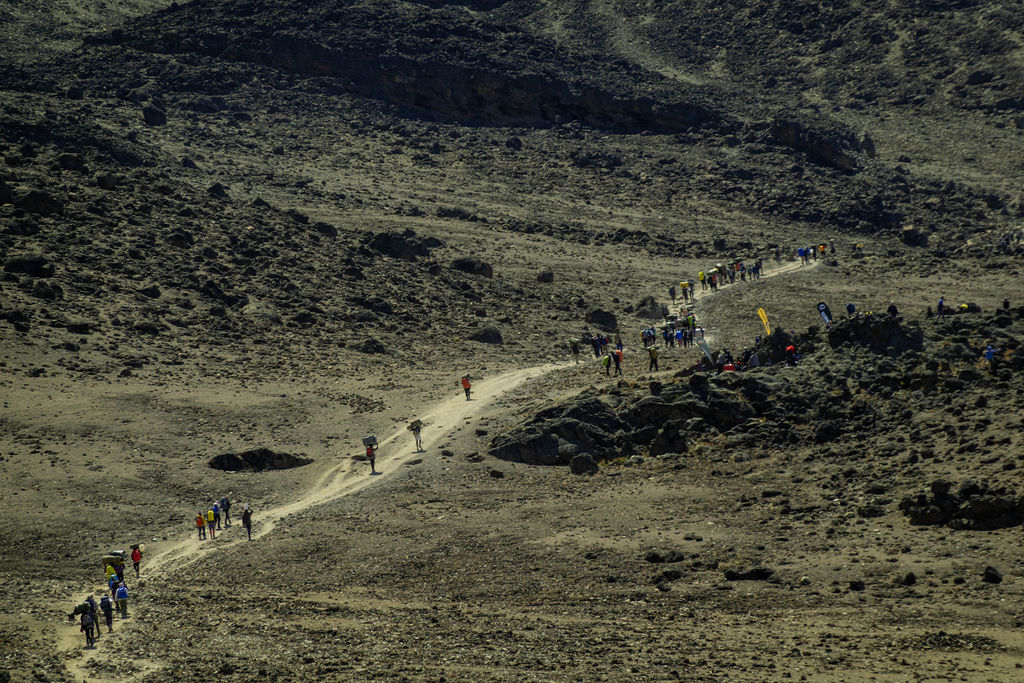
Machame is camping-only, so you sleep in tents at designated campsites rather than in mountain huts. The trail passes through five ecological zones: cultivated farmland, montane rainforest, moorland, alpine desert, and arctic summit. Every day looks and feels completely different. Day one is dense tropical forest with colobus monkeys and filtered sunlight. By day five, you are crossing a lunar landscape of volcanic rock with glacial ice reflecting the sunrise.
The Acclimatization Advantage
The critical feature that separates Machame from shorter routes is its climb-high-sleep-low profile on days three and four. You ascend to the Lava Tower at 4,630 meters during the day, then descend to Barranco Camp at 3,976 meters to sleep. This exposure to higher altitude followed by recovery at lower altitude triggers your body's red blood cell production more effectively than simply climbing steadily upward. It is the single most important acclimatization technique available on any standard route.
Machame Day-by-Day Breakdown
Day 1: Machame Gate (1,800m) to Machame Camp (3,020m). 5 to 7 hours through dense rainforest. The trail is well-maintained but can be slippery and muddy, particularly during rainy seasons. The forest canopy creates a green cathedral atmosphere. Wildlife sightings include colobus monkeys, blue monkeys, and tropical birds. You will sweat heavily in the humid air regardless of fitness level, so wear synthetic base layers from the start.
Day 2: Machame Camp to Shira Camp (3,840m). 4 to 6 hours ascending through moorland. The forest gives way to giant heather, then open grassland with rocky outcrops. Views of Kibo cone emerge above the cloud line. Many climbers notice the altitude for the first time here through mild headaches or reduced appetite. These symptoms are normal and expected at this elevation.
Day 3: Shira Camp to Lava Tower (4,630m) to Barranco Camp (3,976m). 6 to 8 hours. This is the most important day on the route. You climb to Lava Tower for lunch at 4,630 meters, the highest point you will reach before summit night. Many climbers feel genuinely unwell here: headaches, nausea, fatigue, and dizziness. This is your body confronting reduced oxygen for the first time. The descent to Barranco Camp provides relief and triggers the acclimatization response that prepares your body for the summit push two days later.
Day 4: Barranco Camp to Karanga Camp (4,035m). 3 to 4 hours. The day begins with the Barranco Wall, a steep scramble up a volcanic rock face that is the most photographed section of the route. The wall looks intimidating from below but requires no technical climbing skill. You use your hands for balance in a few sections, but the path is wide and the rock is stable. Guides position themselves at the tricky spots. After the wall, the trail undulates across valleys to Karanga Camp.
Day 5: Karanga Camp to Barafu Camp (4,673m). 3 to 4 hours. A short but steep final ascent to the summit staging camp. You arrive by early afternoon, eat an early dinner, and try to sleep before the midnight summit push. Sleep at this altitude is difficult. Most climbers manage a few fitful hours. Do not worry about sleep quality. The adrenaline of summit night will carry you regardless.
Day 6: Summit Day. Barafu Camp (4,673m) to Uhuru Peak (5,895m) to Mweka Camp (3,100m). 12 to 16 hours total. You depart between midnight and 1 AM, climbing in darkness through loose volcanic scree. The pace is extremely slow, perhaps 200 meters of altitude per hour. You reach Stella Point on the crater rim (5,756m) at approximately sunrise. The view from Stella Point across the glaciers and volcanic crater with the sun rising is one of the most extraordinary sights on earth. From Stella Point, you traverse the crater rim for 45 to 60 minutes to Uhuru Peak. After summit photos, you descend the entire mountain to Mweka Camp, covering 2,800 meters of altitude loss in one day. Your knees will remember this day.
Day 7: Mweka Camp to Mweka Gate (1,640m). 2 to 3 hours through rainforest. Summit certificates are distributed at the gate. Your operator drives you back to your hotel in Moshi or Arusha for the hottest shower of your life.
Machame Statistics
Duration: 6 to 7 days (7 strongly recommended). Success rate: 85% on 7-day, 73% on 6-day. Difficulty: Moderate to challenging. Scenery: Exceptional, 5 ecological zones. Crowds: High, busiest route. Camping only: Yes. Mid-range cost: $2,200 to $3,200.
Lemosho Route: The Highest Success Rate (7 to 8 Days)
Why Lemosho Is the Guide's Favorite
Lemosho is the route that experienced operators privately recommend when asked for their personal choice. Its 7 to 8 day itinerary provides the best acclimatization profile of any standard route, and its western approach through the Shira Plateau offers landscapes that no other route matches. KiliDestination Adventures achieves their highest success rates on Lemosho.
The route begins at Londorossi Gate on Kilimanjaro's western flank, ascending through pristine montane forest that sees far fewer trekkers than Machame. The first two days traverse the Shira Plateau, a high-altitude moorland at 3,500 to 3,800 meters that provides gentle, gradual acclimatization while offering panoramic views of both Kibo and Mawenzi peaks. From day three, Lemosho merges with the Machame route, sharing the Lava Tower acclimatization day and Barranco Wall scramble.
The extra day compared to Machame makes a measurable biological difference. Your kidneys have additional time to excrete bicarbonate. Your bone marrow produces more red blood cells. Your breathing rate stabilizes. These physiological adaptations are time-dependent processes that cannot be rushed, which is why Lemosho consistently delivers 5 to 10 percentage points higher summit success than Machame.
Lemosho Statistics
Duration: 7 to 8 days (8 recommended). Success rate: 90 to 98% on 8-day. Difficulty: Moderate. Scenery: Outstanding, Shira Plateau unique to this route. Crowds: Low to moderate. Mid-range cost: $2,500 to $3,800.
Marangu Route: The Coca-Cola Route (5 to 6 Days)
The Budget Option and Its Trade-Offs
Marangu is the oldest established route, the only one with hut accommodation, and the cheapest option because of its shorter duration. These three features make it attractive on paper. The reality is more nuanced.
Marangu's summit success rate is approximately 60% on the standard 5-day itinerary, the lowest of any standard route. This is not because the trail is harder. It is because 5 days does not provide adequate acclimatization time. You ascend steadily without the climb-high-sleep-low profile that Machame and Lemosho use. By day four at Kibo Hut (4,720m), many climbers are already too altitude-sick to attempt the summit.
The 6-day Marangu option adds an acclimatization day at Horombo Hut (3,720m), improving success to approximately 75%. If you choose Marangu, the 6-day version is non-negotiable.
The hut accommodation is a genuine advantage for climbers who dislike camping. Huts have bunk beds with mattresses, dining halls, and basic toilet facilities. The trade-off is that huts are shared with other groups, removing the privacy that camping provides. During peak season, huts can feel crowded and noisy.
Marangu Statistics
Duration: 5 to 6 days. Success rate: 60% (5-day), 75% (6-day). Difficulty: Moderate gradient, easiest trail. Scenery: Good but less varied. Crowds: Moderate. Accommodation: Huts with bunks. Mid-range cost: $1,800 to $2,500.
Rongai Route: The Quiet Northern Approach (6 to 7 Days)
Rongai approaches from the north, near the Kenyan border, making it the driest route on Kilimanjaro. If you trek during rainy season (March to May or November), Rongai offers the best chance of dry conditions because northern slopes receive significantly less precipitation. It is also the least crowded standard route, attracting roughly 10% of Machame's traffic.
The landscape is distinctly different from southern routes. Instead of tropical rainforest, you ascend through pine forest and open heath. The trail gradient is gentle and consistent, making Rongai one of the less physically demanding approaches. The descent follows the Marangu route, giving you two different perspectives of the mountain.
Rongai Statistics
Duration: 6 to 7 days. Success rate: 80% on 7-day. Difficulty: Moderate, gentle gradient. Scenery: Unique northern perspective, pine forest. Crowds: Very low. Mid-range cost: $2,200 to $3,000.
Northern Circuit: The Full Mountain Experience (8 to 9 Days)
The Northern Circuit is the longest and most comprehensive route, circumnavigating the entire mountain. It begins on the Lemosho trail, crosses the Shira Plateau, then diverges north to traverse Kilimanjaro's remote northern slopes before rejoining the summit approach. If you have the time and budget, this is objectively the best route on the mountain.
The 8 to 9 day duration provides unmatched acclimatization. Success rates exceed 95%. The northern traverse passes through terrain that no other route touches, offering 360-degree views of the mountain and genuine wilderness solitude. You may not see another trekking group for entire days. For experienced trekkers who have done multi-day hikes before and want the most immersive Kilimanjaro experience possible, the Northern Circuit is unbeatable.
Northern Circuit Statistics
Duration: 8 to 9 days. Success rate: 95%+. Difficulty: Moderate, long but not steep. Scenery: Unmatched, full circumnavigation. Crowds: Extremely low. Mid-range cost: $3,000 to $4,500.
Umbwe Route: The Steepest Challenge (5 to 6 Days)
Umbwe is the steepest and most direct route, ascending rapidly through dense forest and steep ridgeline to Barranco Camp in just two days, covering altitude that Machame spreads across three. It is beautiful, quiet, and physically demanding. The rapid ascent means significantly higher altitude sickness risk and a success rate of only 70%. Umbwe is not recommended for first-timers or anyone without significant high-altitude trekking experience.
Duration: 5 to 6 days. Success rate: 70%. Difficulty: Very challenging. Cost: $2,000 to $2,800.
Shira Route: The High Start (7 Days)
Shira begins at 3,600 meters via vehicle transfer, skipping the forest zone entirely. The advantage is less total walking. The disadvantage is reduced gradual acclimatization because you start at significant altitude. Shira is rarely recommended standalone and is often treated as a Lemosho variant.
Duration: 7 days. Success rate: 85%. Difficulty: Moderate. Cost: $2,400 to $3,200.
Which Route Should You Choose?
Best for first-timers with moderate fitness: Machame (7-day). The gold standard balance of success rate, scenery, and value.
Best for maximum summit probability: Lemosho (8-day) or Northern Circuit (9-day). The extra days provide measurably better acclimatization.
Best for budget-conscious climbers: Marangu (6-day). Lowest cost but lowest success rate. Only choose the 6-day version.
Best for rainy season trekking: Rongai. Northern approach receives less rainfall.
Best for experienced trekkers seeking solitude: Northern Circuit or Umbwe.
Best for climbers who dislike camping: Marangu. The only route with hut accommodation.
How Route Choice Affects Your Total Cost
Route cost scales directly with duration because park fees are charged per day. A 5-day Marangu costs roughly $850 to $1,000 in park fees. A 9-day Northern Circuit costs $1,300 to $1,500. Operator fees also increase with duration: more days mean more food, more porter labor, and more guide time. However, the incremental cost of adding one or two extra days is small relative to the total trip investment, and the return in summit success is enormous. Spending an extra $300 to $500 on a longer route that increases your success probability from 60% to 95% is the best value decision you can make.
For a transparent, all-inclusive quote on your preferred route, contact KiliDestination Adventures. They will recommend the optimal route based on your fitness, schedule, and goals.
Frequently Asked Questions About Kilimanjaro Routes
Which Kilimanjaro route has the highest success rate?
The Northern Circuit (8 to 9 days) at 95%+, followed by Lemosho (8 days) at 90 to 98%. Both benefit from superior acclimatization profiles and longer durations.
Which Kilimanjaro route is easiest?
Marangu has the gentlest trail gradient, but its shorter duration makes altitude sickness more likely. Lemosho is physically moderate with longer duration that produces better adaptation, making it arguably easier in terms of summit probability.
Which route is cheapest?
Marangu (5 to 6 days) due to shorter duration. But the cost-per-successful-summit is often higher than longer routes because the lower success rate means many climbers pay the full price without reaching the top.
Can I switch routes during my climb?
No. Once you enter the park on your designated route, you must follow it. Routes converge near the summit but approach paths are fixed.
How do I choose between Machame and Lemosho?
If you have 7 days: Machame. If you have 8 days: Lemosho. The extra day on Lemosho adds significant acclimatization value. Both share the same final three days. Compare details on the KiliDestination trekking page.
What route does KiliDestination recommend for first-timers?
7-day Machame for most first-timers. 8-day Lemosho for those who want maximum success probability. Learn about the KiliDestination team and their route-specific expertise. Explore Tanzania safari packages to pair with your trek. Visit the KiliDestination blog for more planning resources.